
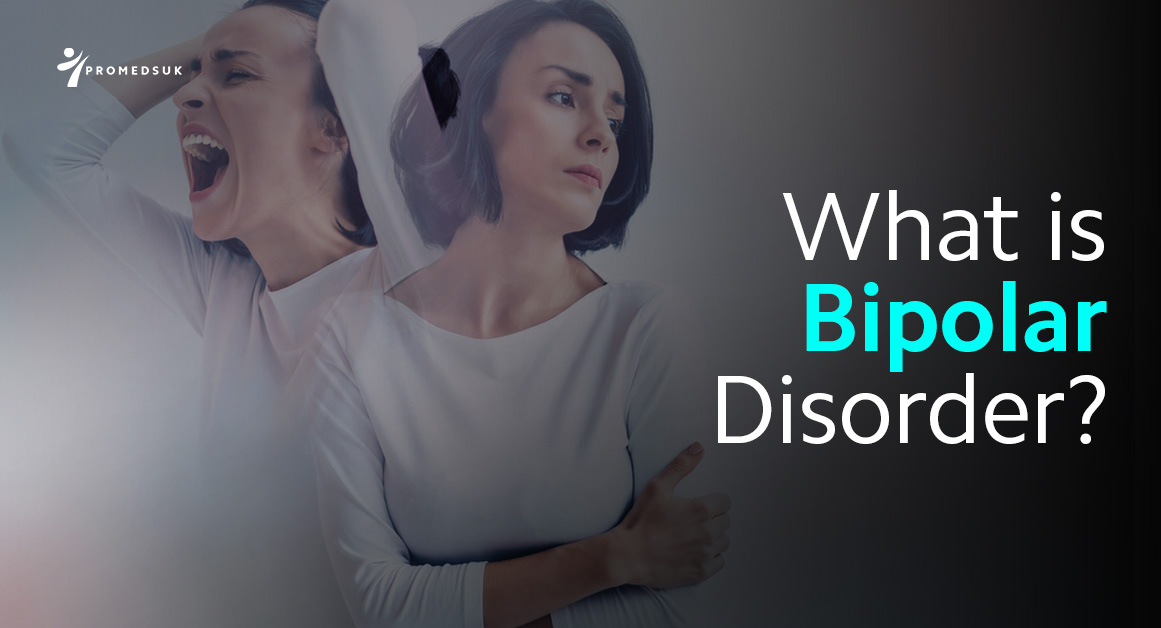
Bipolar Disorder is a mental health issue that usually affects a person’s mood. If you or someone you know is going through hypomanic episodes, depressive feelings and some potential psychotic symptoms then it’s bipolar disorder. These symptoms may disrupt your sleep, behavior and daily life activities. But treatment and support may help you stay stable. If you are searching for a simple answer of “what is Bipolar Disorder” then we have the accurate information for you. At ProMeds UK, we don’t only tell people about their health problems, symptoms and reasons, we also provide the right solutions. From this guide you’ll get to know everything about this manic depression (previous name of bipolar disorder) including how to manage it.
There is not a single type of bipolar disorder there are different types and subtypes of it. They vary depending upon how a person experiences them and how severe are the symptoms. Depending on these mood changes and symptoms, a doctor first decides the type and then diagnoses the patient with that particular type. Here are the main types bipolar disorder:
Bipolar 1 occurs when a person experiences a manic episode lasting longer for 1 week or longer. Some depressive episodes are also possible but not necessary for all.
When someone goes through at least one period of hypomania that lasts for 4 days or longer, he might be going through Bipolar 2. It sometimes also involves at least one depressive episode. Hypomania is not as severe as mania but can still affect daily life tasks.
Individuals experiencing repeated periods of hypomanic and depressive symptoms over the course of two years might be going through Cyclothymia. Their symptoms might not meet the complete criteria of Bipolar 1 or Bipolar 2 but they still affect daily life very much. We have also seen some cases where cyclothymia developed into Bipolar 1 or Bipolar 2.
Rapid cycling can occur if a person goes through four or more manic, hypomanic, depressive or mixed episodes within a single year. These episodes can last for some days to weeks and sometimes even for months, with stable periods in between. Rapid cycling is often categorized as a subtype of bipolar disorder not a separate type.

One might be going through a mixed bipolar state if he is experiencing depression and mania/hypomania at the same time together or with a very little time in between.
As obvious from the name, when a person experiences mood episodes regularly for a particular time of the year or season, he is going through seasonal bipolar issues.
When someone’s symptoms are not clearly fitting into any category of bipolar disorder then it is named as unspecified bipolar. But this does not mean that the person’s mental condition is not serious or he doesn’t need any treatment. It is still a serious issue and should be treated timely.
First thing you need to understand is that bipolar disorder is not completely curable but it is highly manageable. With the right treatment & medications most people with this condition can achieve stability in the long-term and get back to their lives. Without proper treatment, people may experience worse mood episodes over time. Patients might experience manic episodes known as high periods or depressive episodes called low periods. A person feels happy, energetic or invincible like he is on nootropics during a manic episode. While during a depressive episode he feels sad, low on energy and withdraws socially.
Most doctors combine mood-stabilizing medications and psychotherapy as an effective long-term treatment for bipolar disorder. Because this condition is a chronic brain disorder, consistent medical support and self-care (like maintaining regular sleep patterns) are necessary to prevent mood episodes. To get started on building a personalized management strategy, consult with an expert (psychiatrist). He may advise you to take counselling therapy (talk therapy) like:
Another thing your psychiatrist will advise you is to take mood-stabilizing medications like lithium or valproate and atypical antipsychotics like lurasidone or quetiapine. But if anxiety is co-occurring with your bipolar disorder then you might need anxiety medication too. It is necessary to use them with care and in combination with primary mood stabilizer. The latest NHS England survey found that 35.6% of people who screened positive for bipolar disorder reported taking anti-anxiety pills to manage their symptoms effectively.
There are several effective anxiety medications in the UK and almost all of them can only be bought with a proper prescription. It is because of their addictive properties. They calm down the overactive nerves in the brain to help the user to relax during a manic episode. But only use them according to your doctor’s prescription. Long-term use can lead to addiction and dependence and unforeseen side effects. Here are the most famous anxiety medicines in the UK that you can get from ProMeds UK at highly competitive rates:
Bipolar disorder is a mental disorder identified as abnormally elevated mood and periods of depression. These episodes of mania or depression can last for days to weeks, and in some cases months. While this condition is not completely curable and doctors also don’t know the exact reason behind it. But with long-term personalized treatment it is highly manageable. Doctors often advise bipolar disorder patients to undergo certain therapies and use medications to get back to their lives.
Without proper treatment these symptoms can become worse, like a person can feel severe depression and experience insomnia. Patients start to take sleeping pills for these symptoms and think everything will be alright but that’s not true. You need to consult an expert to get proper medication and treatment prescribed. If your manic episodes are related to anxiety, you can get authentic anxiety pills from ProMeds UK at the best price. We deliver all our medicines including painkillers overnight at your doorstep in safe and secure packaging. You can even save more while paying via Bitcoin.
Q: Is it possible to have bipolar disorder from birth?
A: No, it’s not possible to have fully developed bipolar disorder from birth. But a child can be born with a genetic vulnerability or predisposition to developing it later in life.
Q: Is bipolar disorder curable?
A: No, bipolar disorder is not curable but it is a highly manageable mental disorder. The right long-term care plan can effectively help to manage this disorder and achieve stability.
Q: Is bipolar disorder related to anxiety?
A: Anxiety and Bipolar disorder are not the same but they are deeply and directly related. Researchers have found out that approx. 40% to 50% of bipolar disorder patients also experience long-term anxiety.
